
120th metaPhorest Seminar
Monday, March 16, 2026, 19:00–21:00
120th metaPhorest Seminar by Akihiro Kubota
This event will be primarily in Japanese, but questions and comments in English are also welcome.
For the March 16 metaPhorest Seminar, we are delighted to welcome Akihiro Kubota, a pioneering figure in media art whose work spans science and art, from biology and outer space to quantum technologies. Kubota has supported metaPhorest in various ways since its founding, and in this seminar he will discuss his recent work on quantum art and related projects.
This will be a rare opportunity to hear directly from one of the leading practitioners at the intersection of art, science, and technology. We warmly invite you to join us.
Date & Venue
March 16, 2026 (Mon.) 19:00–21:00
Waseda University Research Facility for Advanced Biomedical Sciences (TWIns), 3rd Floor, Seminar Room 2
(Please note that this is a different room from our usual venue, although it is in the same building and on the same floor.)
https://maps.app.goo.gl/Wy23SqPPMo3P7V8JA
ONLINE
This seminar can also be held online. Zoom Link
Quantum Computers as Natural Computers (and Art)
Akihiro Kubota
A quantum computer is not simply a faster classical computer. Rather, it is an unconventional machine of natural computation that performs calculations through the direct manipulation of matter in quantum states.
If nature can be simulated by classical computers, then it should also be possible for nature itself to simulate classical computation. While classical computing processes information by translating abstract logic into physical media, quantum computing employs the quantum-mechanical behavior of matter itself as a computational resource.
Extending this concept of natural computation further may even allow for an ontological shift in which the material universe itself is understood as a vast information-processing system. At the very least, in quantum computation—where symbols and physical entities are inseparably integrated—the unknowability and indeterminacy of quantum phenomena may provide a pathway toward constructing new realities.
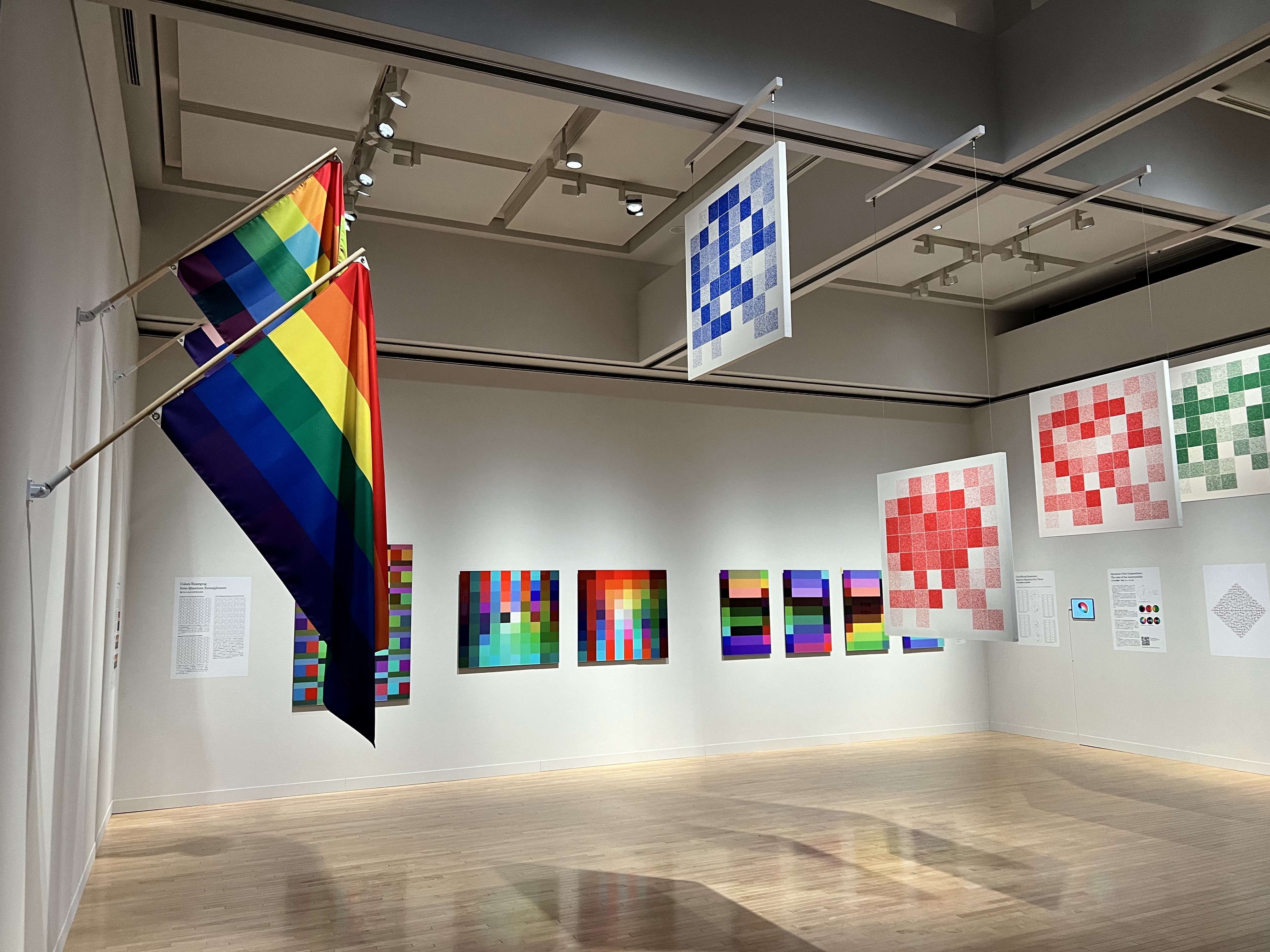
Through a collaboration with the Quantum Information and Quantum Biology (QIQB) group at Osaka University, I have been able to create artworks using actual quantum computers. Phenomena such as noise and decoherence—often regarded as errors to be eliminated or corrected—can instead be understood as moments when computational processes leak into the physical world. Within these leaks reside the generative and creative forces of the world itself.
Rather than focusing on reproducible symbolic processing or numerical calculation, I am interested in singular, unrepeatable computations that bear the traces of material intervention. Such one-time-only encounters with computation suggest new possibilities for computer art.
Related Publications
Quantum Computer Art Studies https://hemokosa.com/QCA/QCAbook.pdf Quantum Color Composition https://hemokosa.com/QCA/QCCtext.pdf