

layout: doc outline: deep prev: text: 'Seminars' link: '/seminars/'
127th metaPhorest Seminar
Friday, November 20, 2026, 19:00–21:00
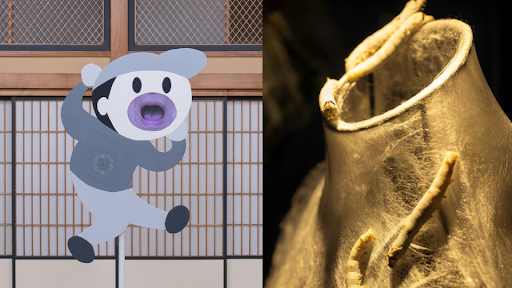
127th metaPhorest Seminar by Masaya Mizuta and Akira Fujioka
This event will be primarily in Japanese, but questions and comments in English are also welcome.
At the November 20 (Friday) metaPhorest Seminar, we are pleased to welcome artist Masaya Mizuta, whose practice explores the relationships between animals and humans. He will be joined by metaPhorest member Akira Fujioka for a discussion on the relationships between humans and nonhuman beings. Drawing on their respective practices, including fieldwork, interviews, and research on silkworms, they will reconsider how humans relate to other living beings.
There will also be time for informal discussion after the seminar. We look forward to seeing you there!
Friday, November 20, 2026, 19:00–21:00
Seminar Room 3, 3rd Floor, Waseda University Joint Institution for Advanced Biomedical Sciences (TWIns)
https://www.waseda.jp/top/access/twins
ONLINE (The video quality of the online stream may be limited, so we encourage participants to attend in person whenever possible.)
This seminar will also be available online. Zoom Link
Fieldwork and Narratives Exploring the Boundaries Between Humans and Nonhumans (Animals and Living Beings)
In this seminar, artist Masaya Mizuta, who explores the contradictions and tensions inherent in relationships between animals and humans through local fieldwork and interviews, and Akira Fujioka, who investigates life from both humanities and scientific perspectives through silkworms and other subjects, will discuss the complex intersections between human society and nonhuman beings. In the first half, Mizuta will trace the development of his artistic practice, from his early works as a product design student to his Grand Prix-winning work at Kobe Rokko Meets Art 2024 beyond, and his project Kaiko-roku in Toyota City. Connecting the perspective of products—objects whose functions and forms are shaped by human needs—with research into local industrial heritage and history, he will explore how humans have managed and systematized living organisms and nature, and how these processes can lead us to reconsider the relationships underlying them. In the second half, Fujioka will introduce his approaches to studying life, particularly through silkworms. His research examines the nature of silkworms, which cannot survive without human care, as well as the material and environmental dimensions of life, drawing on both historical contexts and scientific observations. The session will explore how, in attempting to control living organisms and objects, humans themselves gradually become incorporated into the very systems they create. Moving beyond a human-centered perspective, we will consider what surrounds us and how we might coexist with beings different from ourselves.
Masaya Mizuta
Born in Aichi Prefecture in 1998 and currently based in Kyoto, Masaya Mizuta graduated from the Design Strategy Course at the Graduate School of Design, Kyushu University. His artistic practice explores the relationships between animals and humans. Through research primarily based on interviews about how humans interact with particular animals, he identifies contradictions and moments of discomfort that become starting points for his artistic works. He mainly works with video, mechanical devices, text, and sound. His recent exhibitions and presentations include Koganecho Bazaar 2026, Kobe Rokko Meets Art 2024 beyond, and ATAMI ART GRANT 2023. His major awards include the Grand Prix at WACCA ART AWARD 2024 and the Grand Prix of the Open Call Competition at Kobe Rokko Meets Art 2024 beyond.
https://masayamizuta.com
Akira Fujioka
Born in Nagano Prefecture in 1997, Akira Fujioka completed his master's degree at the Graduate School of Advanced Science and Engineering, Waseda University, in 2022. He has been a member of metaPhorest since 2020, creating artworks and conducting research centered on silkworms. His practice seeks to reconsider the relationships between silkworms and humans by investigating the ecological characteristics of silkworms, as well as the cultural history of their relationships with humans, including customs, religion, and art.