124th metaPhorest Seminar
Friday, October 16th, 2026, 19:00–21:00
124th metaPhorest Seminar by Hanna Saito
This event will be primarily in Japanese, but questions and comments in English are also welcome.
10/16(金)のmetaPhorestセミナーでは、齋藤帆奈さんにお話しいただきます。セミナー後の懇談タイムもあります。ぜひお越しください!
Friday, October 16th, 2026, 19:00–21:00
Waseda University, Tokyo Women's Medical University Joint Institution for Advanced Biomedical Sciences (TWIns), 3F Seminar Room 3 https://maps.app.goo.gl/Wy23SqPPMo3P7V8JA
ONLINE (The video quality is poor, so please come to the venue in person if you can.)
This seminar can also be held online. Zoom Link
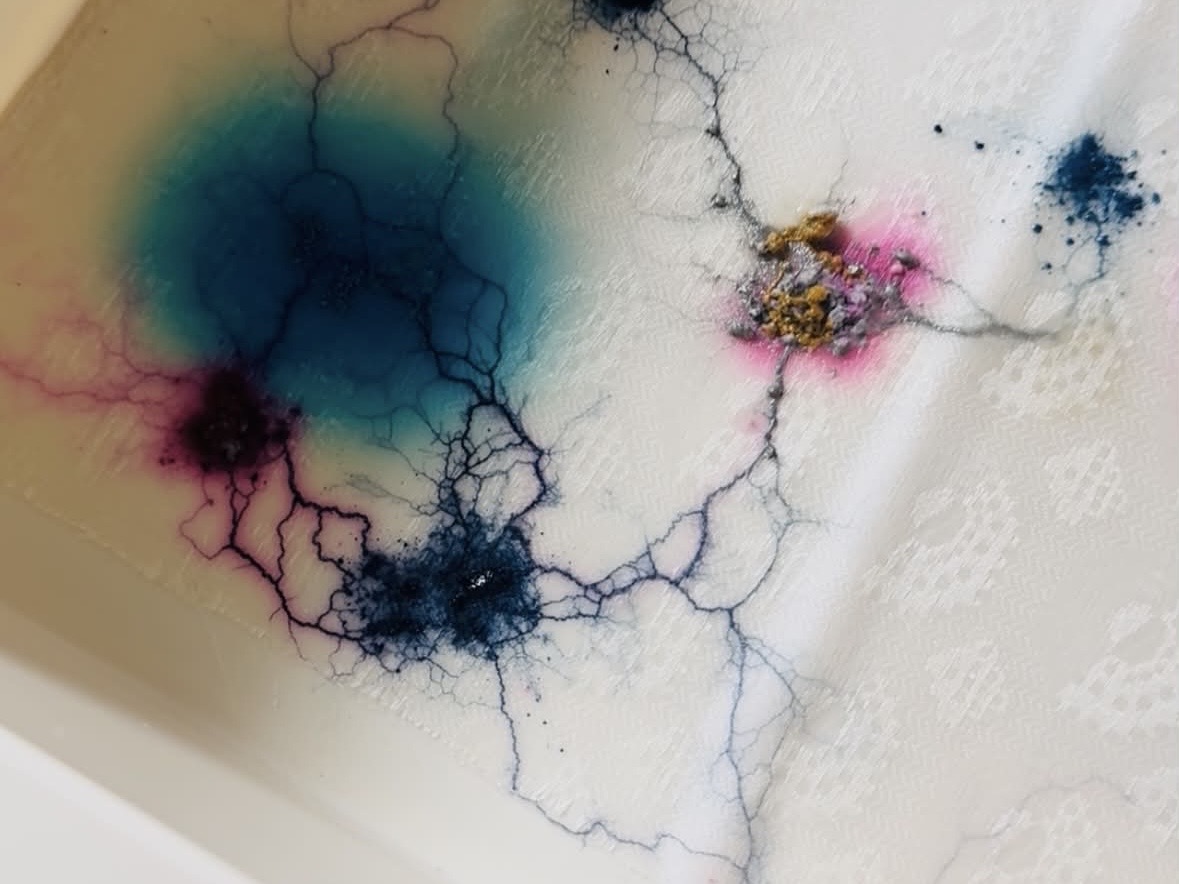
Drawing with Slime Molds: What New Melody Might Emerge from Variations of Slimography?
【Overview】
In this workshop, participants will experience Slimography, a technique that records the movement trails of slime molds through color, using multiple unidentified slime mold strains collected from the wild. Participants will inoculate filter paper with slime molds, feed them food mixed with pigments or food coloring, and observe the trails and patterns that emerge.
【Concept & Details】
Science is often understood as a pursuit of universality, while art is seen as a pursuit of individuality. However, in 1725, the philosopher Francis Hutcheson discussed "uniformity amidst variety" as a principle of beauty found in both art and nature in his An Inquiry into the Original of Our Ideas of Beauty and Virtue. Diversity and the existence of an underlying common order are not necessarily contradictory.
In my usual artistic practice, I believe that my own habits of caring for slime molds and arranging their environments also influence their behavior and the formation of my works. What, then, might happen if different people were to engage with the slime molds? What different responses and forms of expression might emerge from these interactions?
In this workshop, I invite participants to try the Slimography technique that I use in my own practice. The results could be understood as a series of "variations" emerging from a single method, each shaped by the particular relationship between a slime mold and the person interacting with it.
This creative process shares certain characteristics with scientific experimentation: preparing an environment, providing materials, and observing the responses of living organisms. At the same time, it involves numerous intertwined variables. Wild strains are used without isolation or pure cultivation, participants' ways of interacting with the organisms are not controlled, and a variety of pigments and food colorings are introduced. Could such entanglements reveal universal properties of life and nature that might otherwise remain unnoticed?
I would also be delighted if participants continued to share photographs, observation records, and their own approaches to caring for the slime molds through a shared online platform after the workshop.
By bringing together diverse relationships between living organisms and humans—far beyond what I could explore through my individual practice—what kind of "main melody" might emerge from these different variations?
I hope we can consider together how the knowledge emerging from such a process might differ from, or overlap with, the knowledge obtained through controlled scientific experiments.
Hanna Saito
Hanna Saito is a contemporary artist born in 1988. After graduating from the Glass Course in the Department of Crafts at Tama Art University, she joined metaPhorest, a biological/biomedia art platform, and began developing artistic practices using biological materials. She is currently a doctoral student at the Graduate School of Interdisciplinary Information Studies, the University of Tokyo (Yasuaki Kakehi Laboratory), and has been an Assistant Professor at the Faculty of Information Sciences and Arts, Toyo University, since the 2025 academic year.
Her artistic and research practice encompasses glass sculptures created using scientific glassworking techniques, as well as works involving living organisms, organic materials, and image analysis. In recent years, she has collected and cultivated multiple species of myxomycetes (true slime molds), including wild species, for use in her artistic practice and experiments.
Her work primarily explores the boundaries between nature and society, and between self and other. She seeks to reconsider creativity and artistic production not as acts in which a subject imposes form upon materials, but as processes that emerge through the mutual interactions of multiple systems, involving both synchronization and asynchrony.